From Alhambra Tiles to Nubuck Texture: Design DNA Decoded
Stand at the threshold of the Alhambra's Nasrid Palaces and look down. Beneath your feet, Alhambra tile patterns radiate outward in perfect eight-pointed stars ivory against deep cobalt, terracotta threading through sage each shape locking into the next with the precision of a mathematical proof and the warmth of something unmistakably human. This geometry did not decorate the palace. It was the palace's thinking made visible. Centuries later, the same design intelligence lives on not in stone and glaze, but in the embossed cover of a leather notebook, in the deliberate grain of nubuck, in the way a craftsman's hand moves across a surface and decides, with care, what to leave and what to release. This is the story of a design language that never fell silent.
The Grammar of the Star: Understanding Alhambra Tile Patterns
Every Alhambra tile pattern begins with a single decision: the angle.
From that first choice 45 degrees, 60, 72 an entire world unfolds. The artisan-mathematicians of Al-Andalus understood that geometry was not merely measurement. It was a visual language for expressing order, abundance, and the relationship between the part and the infinite whole. A single tile, held in the hand, seems modest. Placed in sequence, it becomes a landscape.
This is the distinctive quality of Islamic geometric design: it rewards both the passing glance and the sustained gaze. From a distance, the eye reads rhythm and colour. Up close, it discovers intricacy a line that seemed simple is actually a braided path; a shape that looked uniform holds subtle variation at its edges.
The craftsmen of Córdoba, Seville, and Granada spent lifetimes developing this visual grammar. They passed it forward not through written manuals but through the hands master to apprentice, generation to generation, the knowledge living in the angle of a chisel and the memory of a palm.
Nubuck Leather: Texture as a Form of Memory
Nubuck is leather that has been returned to itself.
Full-grain hide, buffed against the grain until its surface opens into a soft, velvety nap this is nubuck. It carries the warmth of suede but with a greater density, a more grounded presence beneath the hand. Run a finger across it and it responds: the fibres shift slightly, leaving a faint trace of the direction you came from.
This quality the way nubuck holds the impression of contact makes it an unusually honest material. It records use without apology. A mark left by a careful hand becomes part of the texture's history, the way a worn stair in an old medina carries the memory of ten thousand footsteps without losing its purpose.
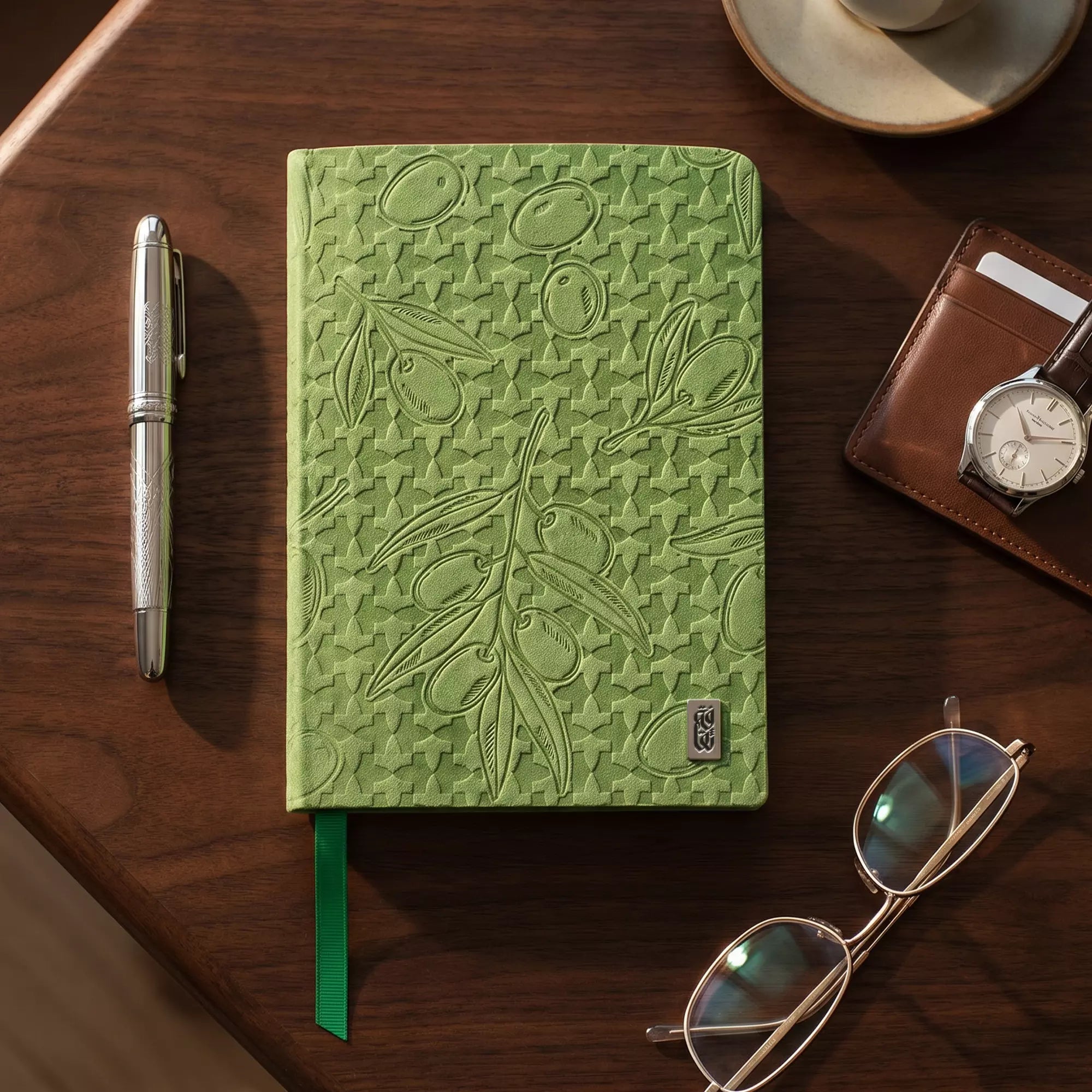
In TAKAFA's Al Andalus Garden collection, nubuck was chosen precisely for this character. The cover does not simply protect the pages within. It participates in the life of the notebook deepening, softening, acquiring a patina that belongs entirely to its owner. No two covers age identically. Each becomes, over time, a portrait of the hands that held it.
Where Geometry Meets Grain: The Design Translation
Translating an Alhambra tile pattern onto a leather surface is not reproduction. It is interpretation.
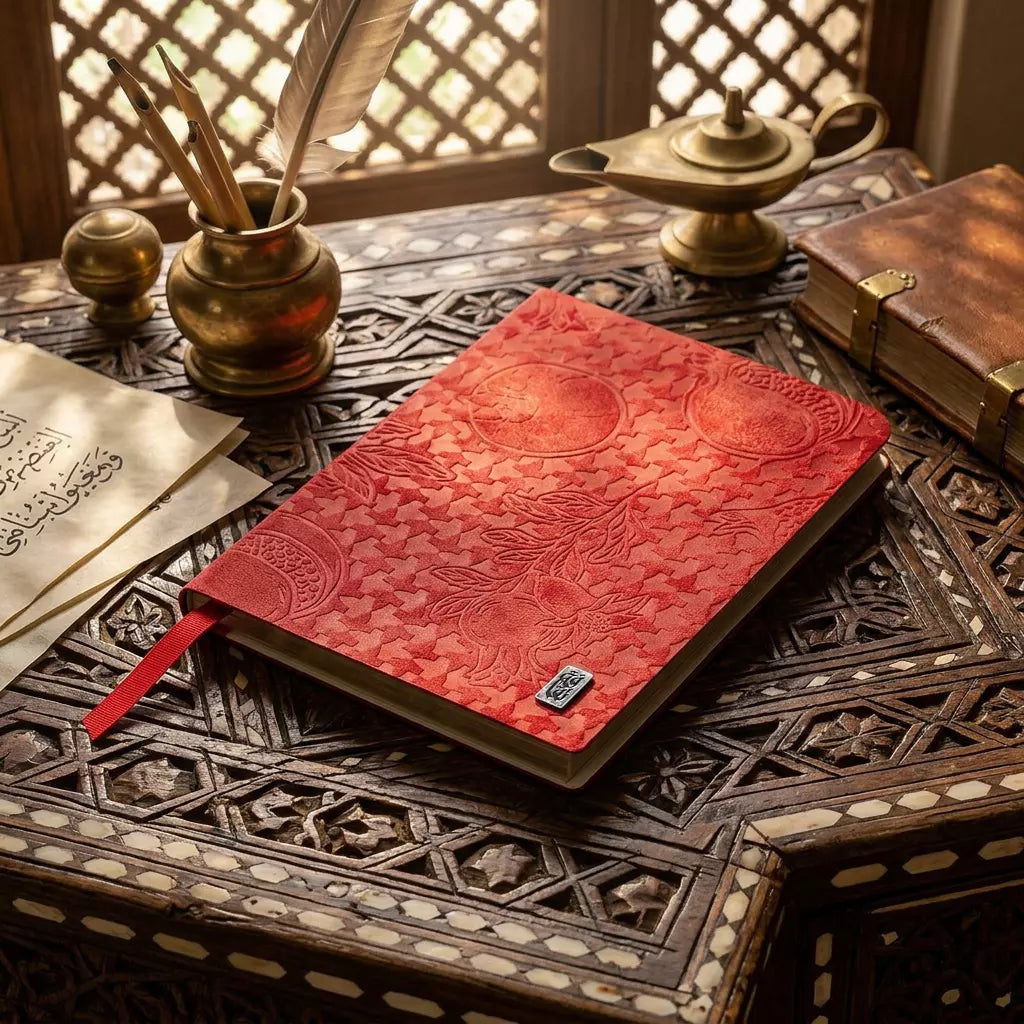
Stone and glaze obey different laws than hide and nap. What reads crisply in zellij the North African and Andalusian mosaic tilework must be rethought when the canvas breathes, gives, and responds to pressure. The embossed geometric motifs on TAKAFA's Al Andalus Garden notebooks were developed with this dialogue in mind: how does the eight-pointed star retain its authority when pressed into nubuck rather than fired into ceramic?
The answer lies in depth and shadow. On a tile, geometry is declared in colour contrast. On leather, it arrives through relief the way light falls into an embossed line, the way shadow gathers in a recessed angle, the slight ridge that the fingertip reads before the eye does. The design becomes tactile as well as visual.
This is a distinction the Andalusian craftsmen would have understood intuitively. They moved fluidly between media stone, wood, plaster, textile carrying the same geometric vocabulary into each, adapting its expression to the resistance and character of the material at hand. The pattern was never the point. The intelligence within the pattern was.
Design as Inheritance, Not Imitation
There is a significant difference between referencing a tradition and being shaped by it. Imitation copies the surface. Inheritance absorbs the principle. When a contemporary object draws genuinely from Al-Andalus heritage, it does not simply borrow the aesthetic vocabulary of eight-pointed stars and interlocking polygons. It carries forward the underlying commitment to craft that honours the intelligence of the eye, to beauty that functions, to objects made worthy of the human hand.
This distinction shapes every element of TAKAFA's design approach:
- Proportion is considered, not approximate. The dimensions of the notebook, the spacing of the embossed motifs, the weight of the leather against the page count each reflects a decision about balance.
- Material honesty is non-negotiable. Nubuck is not simulated. Full-grain Bos Taurus leather is not finished to uniformity. The grain, the slight variation in tone, the natural character of the hide these are preserved because they are the material's truth.
- Craft is visible, not hidden. The hand-stitching, the lay-flat binding, the woven inner pocket these are not concealed beneath a smooth veneer. They are presented as what they are: evidence of a maker's deliberate attention.
An object made this way does not merely resemble the Andalusian tradition. It participates in it carrying a design DNA forward into a new century without severing its lineage.
Conclusion: The Surface That Speaks
Alhambra tile patterns endure because they were never only beautiful. They were intelligent encoding proportion, patience, and a deep understanding of how the human eye finds rest in ordered complexity.
When that same intelligence is pressed into nubuck leather, something remarkable occurs. The object in your hand becomes legible in two directions at once: forward, into the daily life it is made to accompany, and backward, into a civilisation that believed an ordinary surface deserved extraordinary thought.
This is the design DNA that runs through every TAKAFA notebook not as ornament, but as inheritance. Discover the Al Andalus Garden Collection where geometry becomes texture, and every surface holds a story worth reading.