What's the 5° Curved Edge on Takafa Notebooks? Design That Actually Improves Writing
Pick up any notebook made without thought for the hand and you will feel it immediately the blunt corner pressing into the heel of the palm, the slight resistance that registers not as pain but as interruption. Small enough to ignore. Present enough to accumulate. Notebook curved edge design is one of those details so quietly effective that it becomes perceptible only in its absence: the moment you return to a sharp-cornered cover after writing in a notebook whose edges have been considered, the difference is immediate and irreversible. TAKAFA's 5° rounded edge was not added as a finishing flourish. It was solved the way a craftsman solves any problem that stands between the hand and its work with patience, precision, and a clear understanding of what writing, at its best, is supposed to feel like.
The Problem With a Sharp Corner
The corner of a notebook is the point of most frequent contact between the cover and the writing hand.
Every time the hand shifts position between sentences, across lines, in the brief pause of gathering thought it meets the edge of the cover. In a notebook with an unrounded corner, that meeting carries a subtle penalty: a pressure point, a moment of adjustment, a fractional redirection of attention from the page to the discomfort of the hold. None of these moments are significant in isolation. Over the course of an hour of writing, they are constant.
This is the ergonomic argument for notebook curved edge design not that a sharp corner causes harm, but that it introduces friction where there should be none. The hand should meet the cover and settle. It should not negotiate.
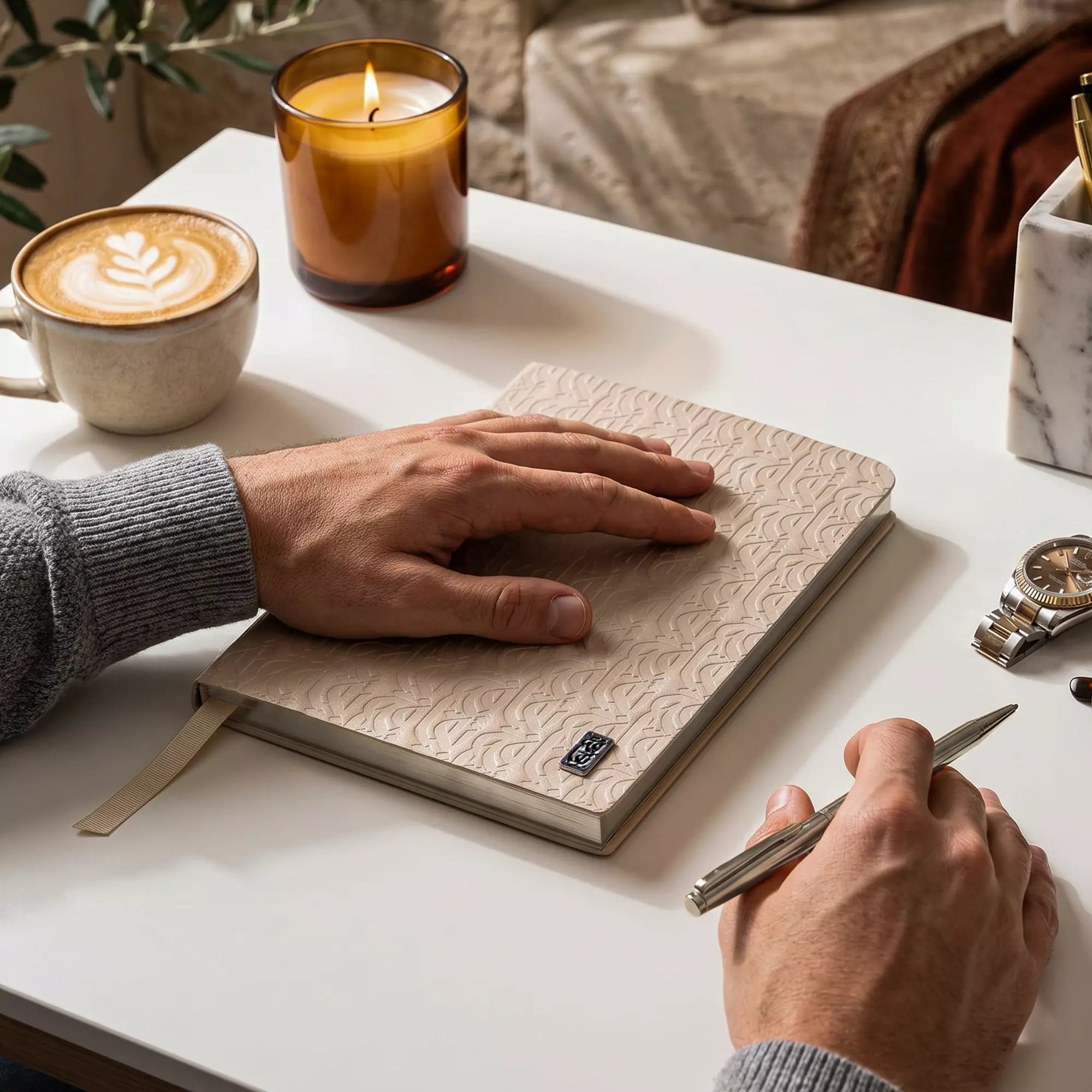
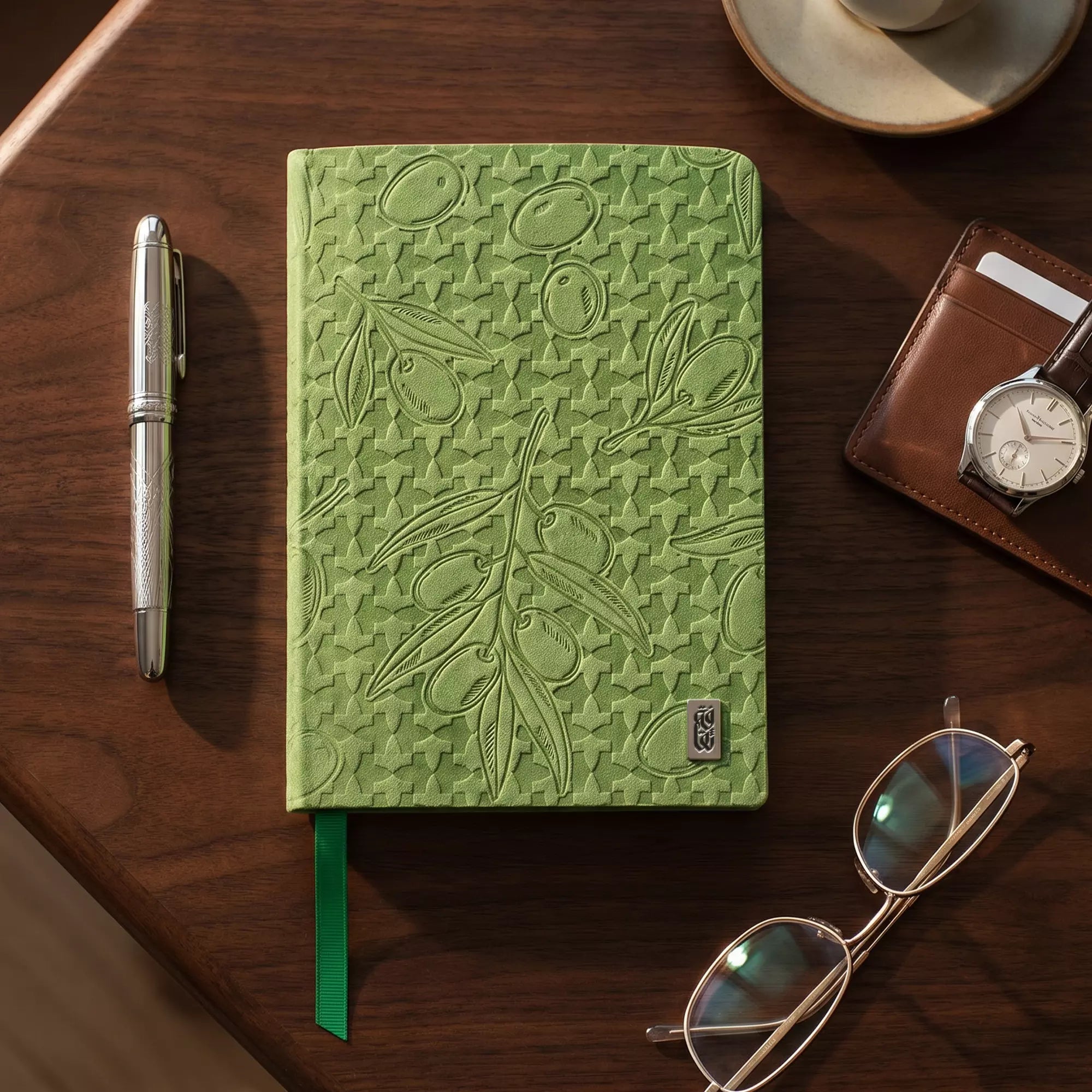
The 5° curve TAKAFA applies to every notebook corner is calibrated precisely for this: enough radius to eliminate the pressure point entirely, while preserving the clean, architectural profile that gives a well-made notebook its visual authority. The edge remains defined. It simply no longer intrudes.
The Craft Logic: When the Detail Serves the Whole
In the Islamic artisan tradition, the detail was never considered secondary to the whole. It was the whole the proof that the maker's attention had extended to every boundary of the object, without exception or hierarchy.
The craftsmen who produced the carved wooden screens of the Alhambra, the mashrabiyya latticework of Cairo's historic quarters, the inlaid furniture of the great Andalusian workshops all operated within a discipline that regarded the edge, the join, the transition between one surface and another, as the truest test of craft quality. Anyone can make a centre. The mastery lives at the margin.
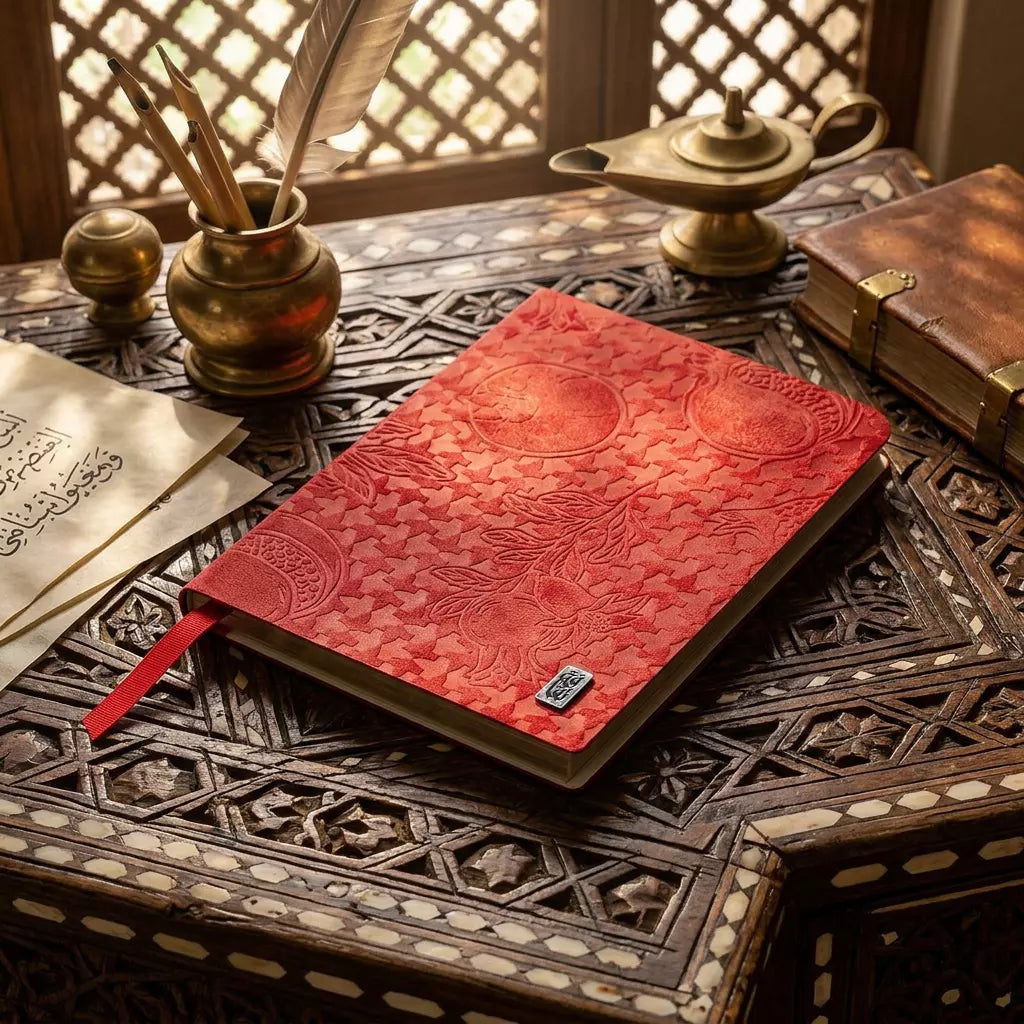
This philosophy applies with equal precision to a leather notebook. The embossed cover, the ivory paper, the lay-flat binding these are the visible centre of the object's quality. But the curve of the corner, the finish of the edge, the way the leather wraps and meets at the spine: these are where the commitment either holds or quietly fails. TAKAFA's 5° edge is, in this sense, not a design feature. It is a declaration of complete attention the maker's refusal to treat any part of the object as beneath consideration.
Notebook Curved Edge Design: How It Improves the Writing Experience
The improvement is cumulative and bodily.
Writing is a long-duration physical activity. The hand holds, shifts, rests, and returns across the span of a session that may last minutes or hours. Every element of the notebook that the hand contacts the cover material, the weight distribution, the surface texture, the edge profile contributes to a physical environment that either supports or subtly undermines the act of writing. Good ergonomic notebook design addresses all of these elements with the same seriousness.
The 5° curved edge contributes to this environment in three specific ways:
- Pressure distribution. A curved corner disperses contact across a small arc rather than concentrating it at a single point. The heel of the hand, resting lightly against the cover's edge, receives no sharp focus of pressure only the smooth, continuous line of a considered curve.
- Grip confidence. When the hand picks up or repositions a notebook, rounded corners allow a more natural, relaxed grip. The fingers find the edge without having to account for a point that might shift unexpectedly in the hold.
- Cover longevity. Sharp leather corners are the first part of any notebook cover to show wear the point being the most vulnerable geometry for abrasion and cracking. A 5° curve distributes the mechanical stress of daily handling across a wider surface, preserving the leather's integrity at its most exposed boundary.
Each of these benefits is modest on its own. Together, across the life of a notebook used daily, they are the difference between an object that gradually resists and one that continues to feel right in the hand long after the first pages are filled.
What the Hand Knows Before the Eye Does
There is a knowledge that lives in the hand before it rises to conscious awareness.
The craftsmen who shaped the handles of instruments in the ateliers of Córdoba and Toledo understood this. A well-balanced tool did not merely function correctly it communicated its quality through the palm, before the eye had time to evaluate it. The hand knew, in the first moment of contact, whether it was holding something made with care.
This is the experience TAKAFA's 5° curved edge contributes to. When the notebook is lifted for the first time, the rounded corner is not consciously registered as a design detail it is simply felt as rightness. The hand settles without effort. The cover sits naturally in the grip. The writing session begins without the small, unnecessary negotiation that a sharp edge would have introduced.
This is what design at its most precise achieves: not novelty, not decoration, but the quiet removal of everything that stands between a person and the full, uninterrupted experience of what they are trying to do.
The Edge That Disappears Into the Work
The finest details in a well-made object are the ones you stop noticing not because they have failed, but because they have succeeded so completely that they require no attention at all.
TAKAFA's notebook curved edge design belongs to this category. The 5° curve is visible to the eye that looks for it, and invisible to the hand that has settled into its writing. That invisibility is the point. The corner has been resolved so that the mind is freed to go where it belongs: to the page, to the thought, to the line that is forming.
In craft traditions from the Mediterranean to the far East, this quality, the detail that serves without announcing itself has always been considered the highest standard of making.