Al-Andalus Geometry in Modern Design: From Moorish Architecture to Contemporary Notebooks
Look closely at the plasterwork of the Alhambra's Hall of the Two Sisters at the muqarnas dissolving upward into a honeycomb of light and shadow, at the dado of interlocking stars that rings the lower walls in silence and precision and you are looking at a conversation between mathematics and beauty that has never truly ended. Al-Andalus geometry in modern design is not a revival. It is a continuation: the same underlying intelligence, expressed through new materials, new hands, new purposes. The eight-pointed star that locked into its neighbour on a twelfth-century palace wall in Granada is still locking, still radiating outward, still organising the space around it on textiles, in architecture, in the embossed cover of a notebook resting on a desk in the present day. Some patterns are not historical. They are simply true.
The Mathematics Beneath the Beauty: Understanding Andalusian Geometric Motifs
Every Moorish geometric pattern begins with a compass and a straight edge two instruments, and from them, an entire cosmology of form.
The artisans and mathematician-designers of Al-Andalus worked within a tradition that regarded geometry not as decoration but as a discipline of the intellect. To produce a perfect tessellation a pattern that extends infinitely across a surface without gap or overlap required a mastery of proportion, angle, and sequence that was the product of years of study. The beauty was not the goal. It was the evidence of understanding.
What emerged from this discipline was a visual language of extraordinary versatility. The same geometric grammar could be carved into the stucco of a palatial corridor, inlaid in wood across a cedar-panelled ceiling, pressed into the surface of glazed zellij tiles, or woven into the warp and weft of a silk textile. The pattern was portable because it was principled it lived in the logic, not the medium.
This portability is precisely what has allowed Andalusian geometric motifs to move so naturally across centuries and into contemporary design. They do not belong to one material or one era. They belong to a way of seeing.
How Moorish Geometric Patterns Translate Into the Contemporary
The challenge of translation is always the same: to carry the principle forward without reducing it to mere surface quotation.
A geometric motif copied without comprehension becomes wallpaper. A geometric motif understood becomes a design decision one that carries the weight of the tradition it draws from and the intelligence of the hand that reinterprets it. The difference is visible immediately, in the proportion, in the way the pattern relates to the edges of its object, in whether it seems placed or arrived.
In contemporary design, Al-Andalus geometry in modern design appears most credibly when it is allowed to behave according to its own principles: when the pattern is adapted to the material rather than imposed upon it, when the scale reflects the function of the object, when the repetition is allowed to create rhythm rather than merely fill space. These are not rules invented for a modern sensibility. They are the same rules the Nasrid craftsmen applied in Granada, eight centuries ago, in a different medium and with different tools.
The intelligence of the pattern is older than any particular application of it. That is what gives it its endurance.
Al-Andalus Geometry in Modern Design: From Architecture to the Objects of Daily Life
There is a particular intimacy in carrying a geometric tradition into the scale of the hand-held object.
Architecture impresses. It surrounds, it dwarfs, it endures in stone and light. But the object held in the hand a book, a notebook, a vessel does something different. It accompanies. It enters the daily rhythm of a life. And in doing so, it brings its visual language into contact with the body in a way that architecture, for all its grandeur, cannot.
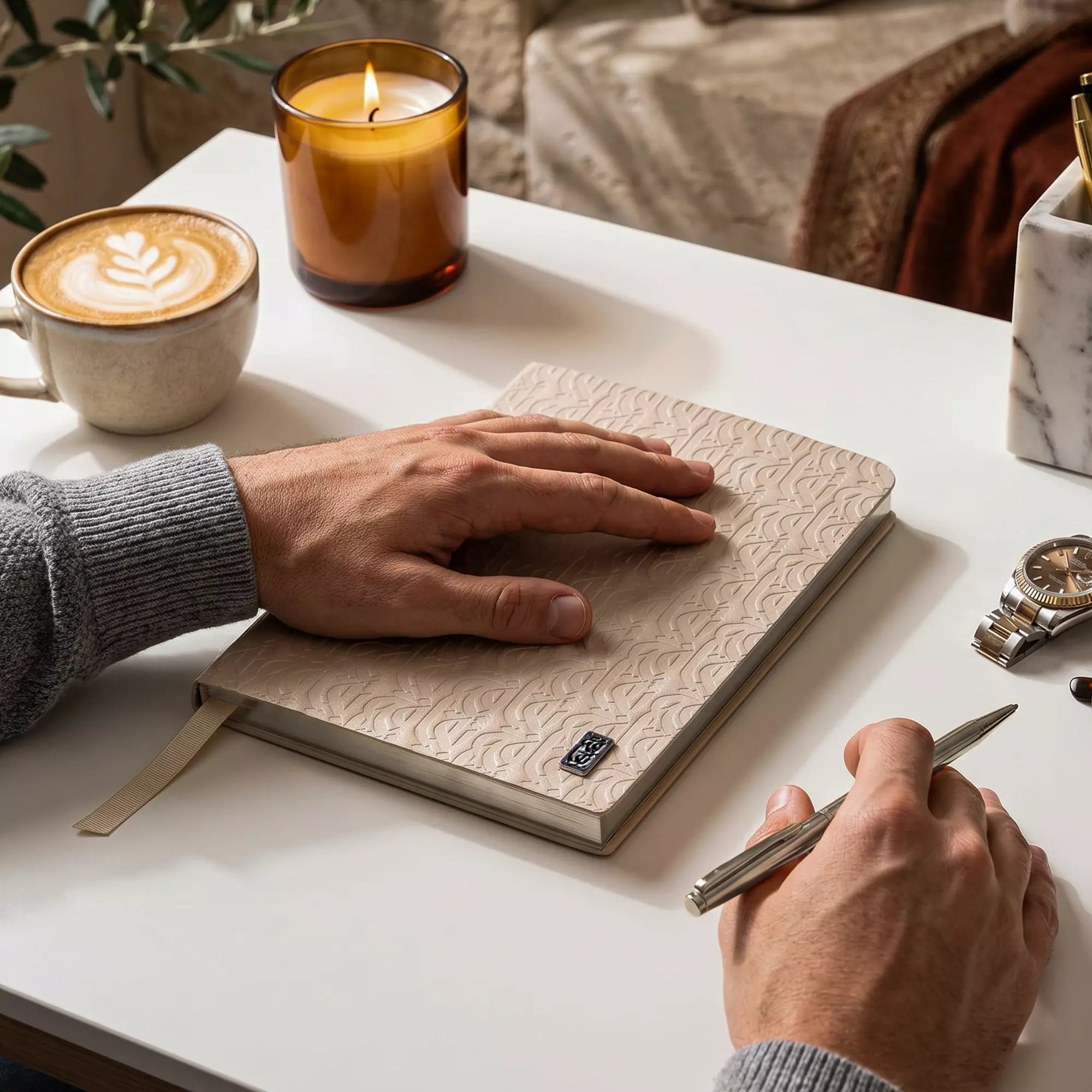
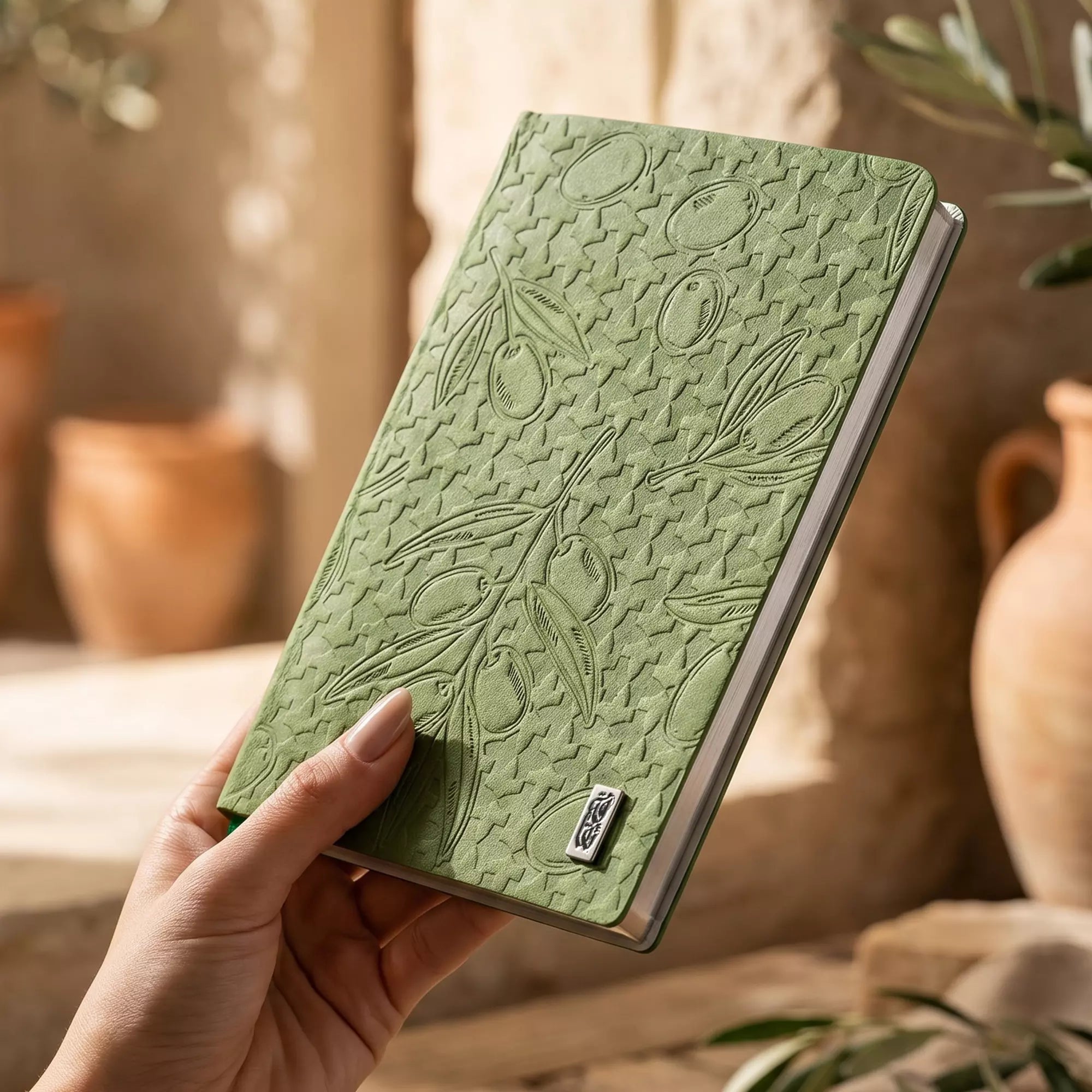
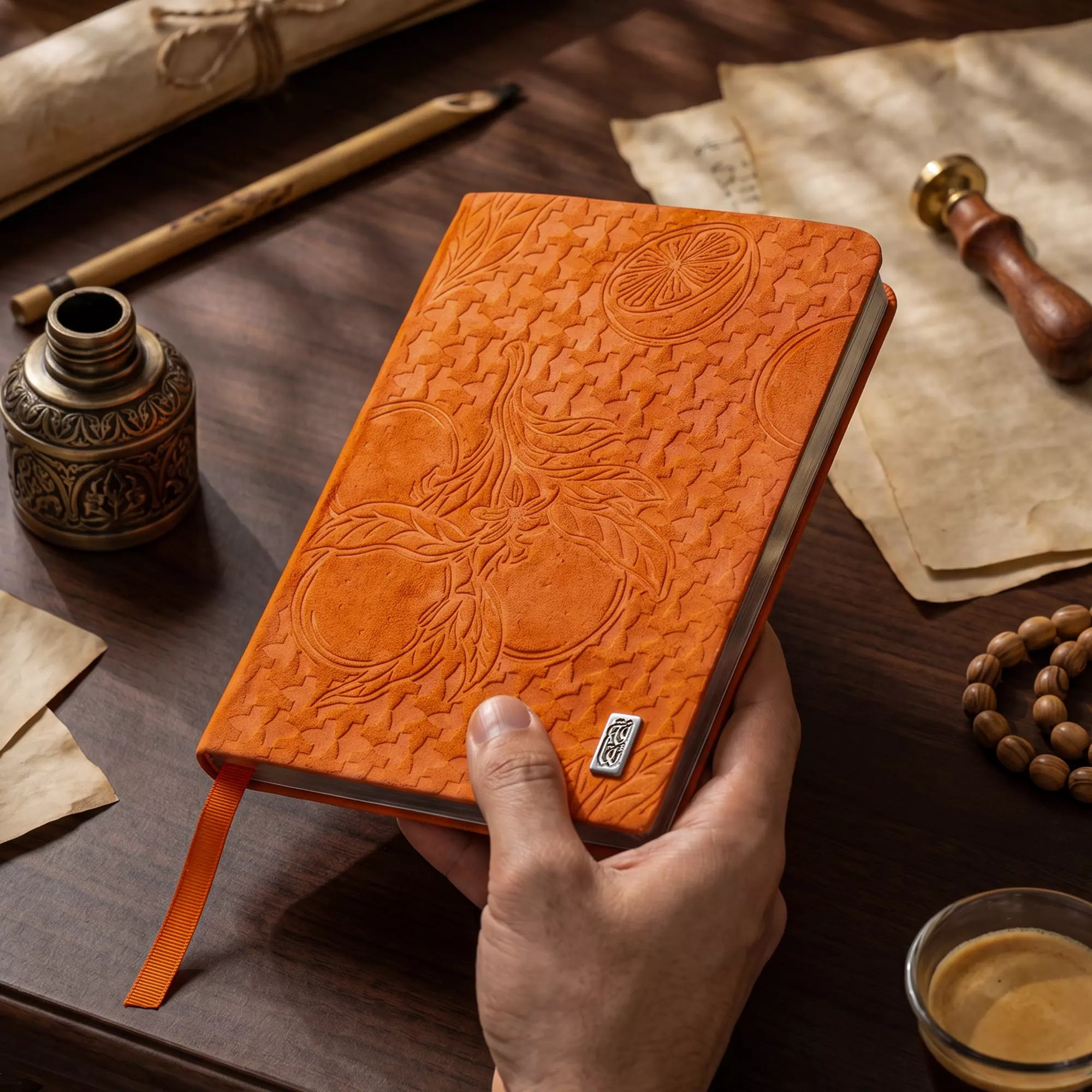
This is the logic behind TAKAFA's Al Andalus Garden collection. The embossed geometric motifs pressed into the nubuck leather cover are not ornamental additions to an otherwise neutral object. They are the object's identity the visual statement that connects a notebook resting on a contemporary desk to the same tradition of ordered beauty that produced the Alhambra's carved plasterwork. The motifs are adapted for leather, calibrated in scale for the dimensions of the cover, deepened in relief so that they are as legible to the fingertip as to the eye.
The result is an object that participates in a very long conversation one that began in the ateliers of Moorish Iberia, passed through centuries of Islamic artisanship across the Mediterranean world, and arrives here: in a notebook made to carry a contemporary life's thinking, held in a cover whose geometry is as purposeful as any arch or tile sequence in the palaces that inspired it.
Why Geometric Inheritance Matters More Than Geometric Trend
Design trends move in cycles. Geometric prints arrive in fashion seasons, saturate interiors catalogues, and recede. What endures is not the trend but the underlying principle and this distinction matters deeply for any object that claims a genuine relationship with the tradition rather than a passing aesthetic alignment.
The Andalusian geometric tradition endures because it was built on principles that remain true regardless of era:
- Infinity within the finite. A tessellation implies that the pattern continues beyond the edge of the surface that what is visible is a fragment of something limitless. This quality gives Moorish geometric patterns their peculiar expansiveness, even at small scale.
- Complexity from simplicity. The most intricate Al-Andalus patterns derive from a small set of generating shapes the triangle, the square, the hexagon combined according to consistent rules. The sophistication emerges from the system, not from arbitrary elaboration.
- Rest within repetition. Unlike patterns that create visual anxiety through asymmetry or random variation, geometric tessellations establish rhythm. The eye finds its way through them without effort, settling into a kind of alert calm the same quality that made them ideal for environments of study and reflection.
These principles do not belong to any single period or place. They are available to any designer willing to understand them rather than simply borrow their image.
A Living Language
Al-Andalus geometry in modern design is not nostalgia. It is a living language one that has survived because it carries something genuinely useful for the human eye and mind: the experience of order that does not confine, beauty that does not demand, and pattern that opens outward rather than closing in.
From the carved muqarnas of Granada to the embossed cover of a leather notebook on a desk in the present day, the same intelligence has been at work patient, precise, and deeply, unmistakably human.
The tradition does not need to be preserved. It needs only to be understood and carried forward by hands willing to learn what it is actually saying.
Discover TAKAFA's Al Andalus Garden Collection where Moorish geometric heritage meets Italian craft, in a notebook made for the thinking life. Explore the collection at takafa.co.uk.