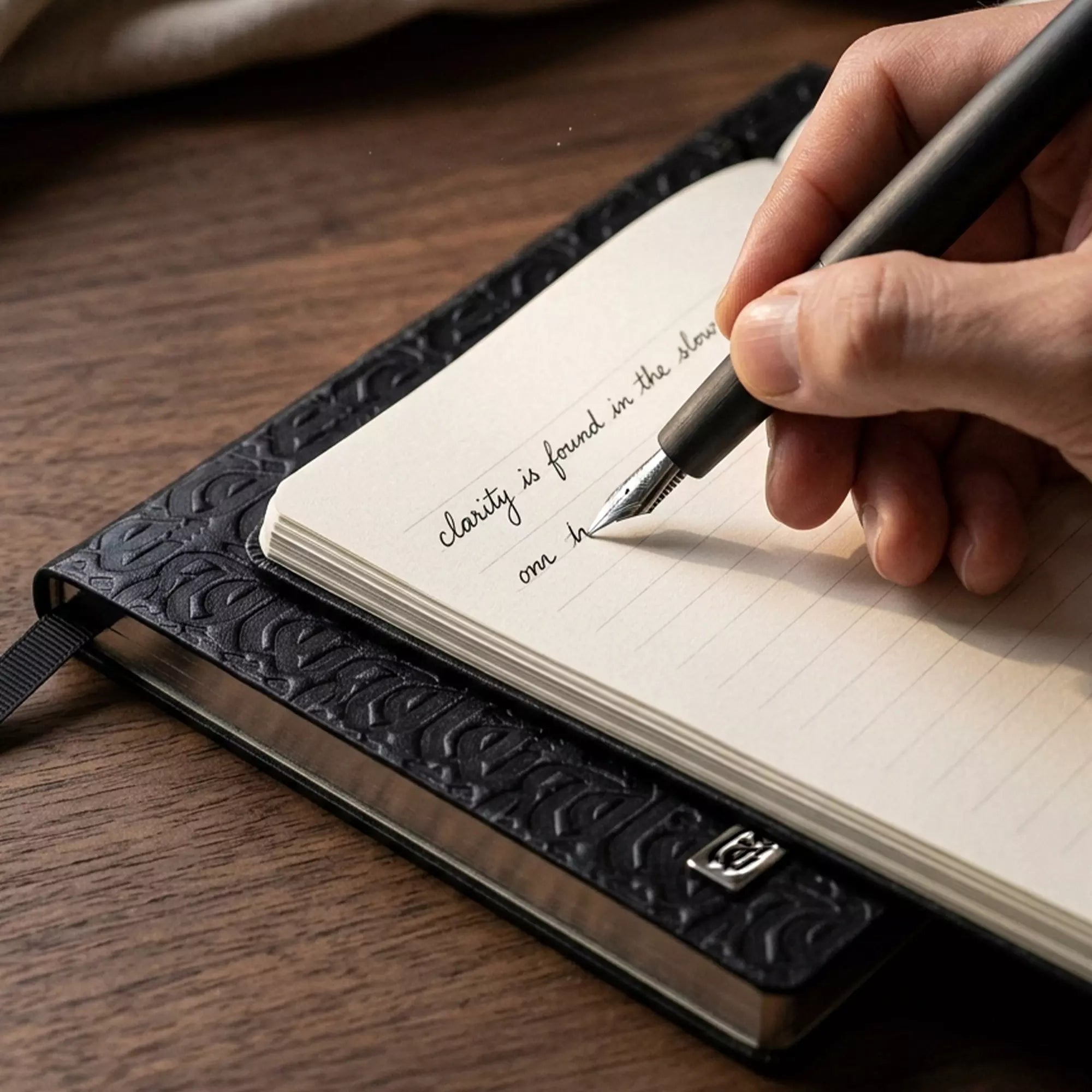
Why Handwriting Beats Typing for Memory? Neuroscience Behind the Pen
There is a particular stillness that settles over you the moment pen meets paper and science now tells us that handwriting beats typing for memory in ways that go far deeper than habit or nostalgia. Imagine a scholar in Córdoba, eight centuries ago, seated beneath a carved arch, drawing the nib of a reed pen across vellum. He does not rush. He cannot. The act of writing by hand forces him to slow, to distil, to understand before he commits a single word to the page.
That deliberateness was not a limitation of his era. It was the gift of his practice. And it is precisely the gift that neuroscience is now, with considerable urgency, asking us to reclaim.
The Hand That Writes, the Mind That Retains
When we write by hand, the brain does not merely record it processes. Neuroimaging studies have shown that the act of forming letters activates a constellation of regions: the motor cortex, the visual cortex, and areas associated with language and memory encoding. This is a richer, more demanding neural choreography than the keystroke has ever managed to produce.
Typing, by contrast, is largely automatic. The fingers find their keys through trained reflex. The brain is freed from the labour of formation but it is also freed from the labour of comprehension. The information passes through without truly landing.
Handwriting forces a bottleneck. You cannot transcribe faster than you think. Every phrase must be weighed, compressed, and reconsidered. This constraint so often perceived as inefficiency is in fact where memory is forged.
What the Scholars of Córdoba Understood First
The intellectual tradition of Al-Andalus was built on the reverence of the written word not merely as a medium of communication, but as a discipline of the mind. The great libraries of Córdoba and Granada housed hundreds of thousands of volumes, each copied by hand, each letter drawn with intention. The scholars who filled those volumes understood intuitively what cognitive scientists are now quantifying: that to write something is to know it.
In the Islamic intellectual tradition, the act of writing carried ethical weight. The student who copied a text did not merely reproduce it he wrestled with it, internalised it, made it his own. Repetition through the hand was seen as a form of contemplation, a way of moving knowledge from the surface of the mind to its roots.
Eastern philosophical traditions carried a similar understanding. From the calligraphic disciplines of Persia and the Ottoman court to the careful notations of Andalusian physicians, the pen was understood not as a tool of speed, but of depth.
Depth Over Speed: The Encoding Advantage of Writing by Hand
Researchers have identified what they call generative processing the cognitive work that occurs when we paraphrase, synthesise, and reconstruct information rather than copy it verbatim. Handwriting almost invariably produces this effect. Typing, when used for note-taking, often does not.
In studies comparing both methods, students who wrote notes by hand consistently demonstrated stronger retention of conceptual information a week after learning, greater ability to apply knowledge to new contexts, more meaningful connections between ideas, and higher recall of the material's underlying logic.
The laptop produces what researchers have described as shallow encoding a digital skimming of the surface, where words are processed but not absorbed. The pen reaches further. It roots the idea in the body, in the rhythm of the wrist, in the gentle resistance of paper grain beneath a moving nib.
There is also the question of distraction. The screen that serves as notepad also serves as portal to messages, to feeds, to the endless ambient noise of the connected world. The notebook offers none of these exits. It is, in the truest sense, a closed room where thinking can occur.
The Vessel That Honours the Practice
A practice as nourishing as this deserves a vessel equal to it. The TAKAFA leather notebook handcrafted in Italy from full-grain Bos Taurus leather and filled with smooth FSC-certified ivory paper is designed with precisely this understanding. The paper carries the pen without resistance or bleed. The leather softens and darkens with use, becoming an archive of your hand's own history.
The Al Andalus Garden Collection, with its Andalusian geometric patterns pressed into Nubuck leather, makes this heritage tangible a daily reminder that to write by hand is to stand in a long and luminous tradition.
The weight of such a notebook in the hand signals something to the mind: this matters. That signal is not decorative. It is neurological. The act of sitting with a beautiful object, of opening it with care, of selecting a pen these rituals prime the brain for deeper engagement. They are, in the language of cognitive science, attention anchors. In the language of any civilisation that has valued knowledge, they are simply good practice.
The Page That Remembers What the Screen Cannot
Handwriting beats typing for memory not because technology has failed us, but because the hand has always carried something the keyboard cannot: the slow, steady intelligence of the body. In returning to the pen, we do not step backward we step inward, into the kind of thinking that built libraries, illuminated manuscripts, and civilisations.